


My MBA was the best decision I ever made. It was also the most expensive.
Between tuition, housing, and life in New York, the final bill sat close to $200,000. Looking back, it was worth every penny.
I don't think everyone needs an Ivy League degree. I don't think prestige automatically makes you smarter, more interesting, or more successful. And I definitely don't think a school name can tell you who you are.
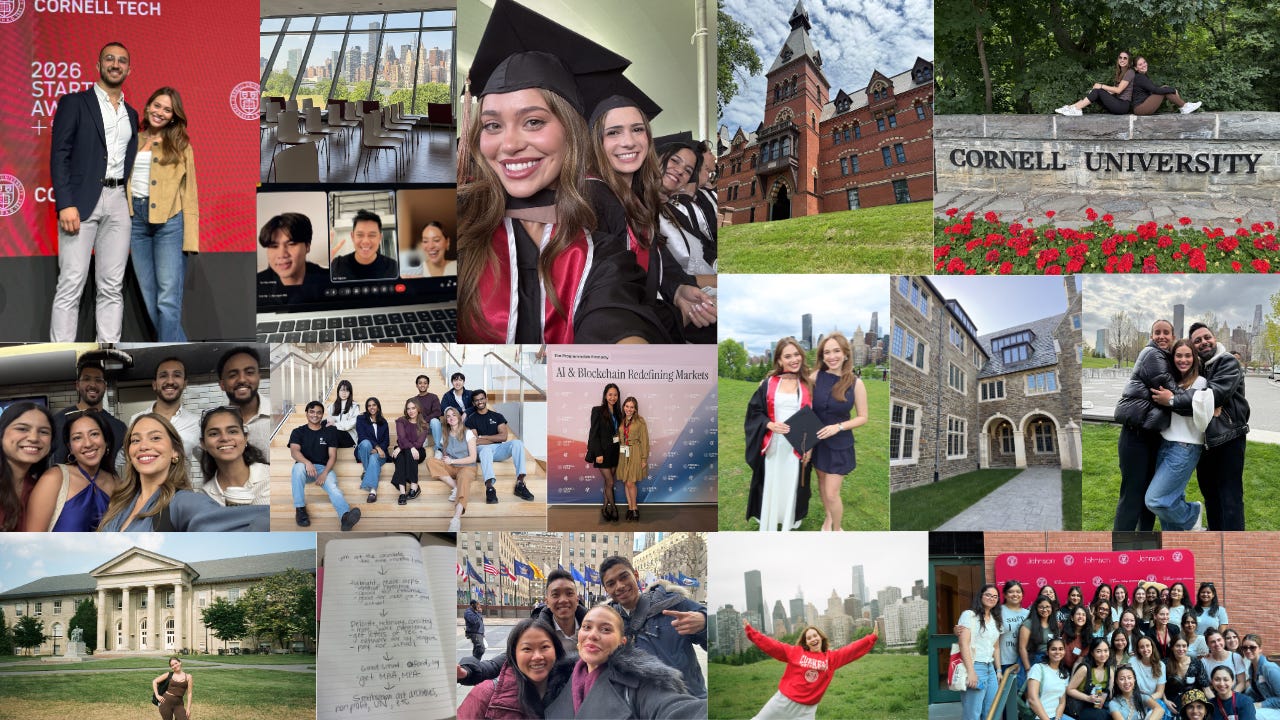
But for me, Cornell became the door to rooms I never would have entered otherwise.
Since high school, I had this idea in my head that I wanted to go to an Ivy League school. At the time, it seemed like the ultimate marker of having “made it.” The kind of place where everyone was brilliant, impressive, well-connected, and somehow already fluent in a world I was still trying to understand.
I knew people who went to those schools, but always from a distance. A relative here, a friend of a friend there. Close enough to make the idea feel real, but far enough away that it still felt like another world.
I first applied when I was seventeen. Every Ivy. Duke. Georgetown. The whole list of schools I had decided meant something.
I got rejected from all of them.
So I did the next best thing. I went to the University of Florida, stayed in-state for undergrad, and I loved it. UF gave me confidence, leadership, independence, and a version of myself I needed to become.
But the dream persisted.
I applied to Georgetown again while I was at UF. Rejected again.
After graduating in three years, I moved through a few versions of the life I thought I was supposed to want. I worked in politics, then in banking. I learned a lot, grew up a lot, and slowly realized that even though I had built a respectable path, I still wanted something bigger from my career and my life.
I wanted space to recalibrate. To step outside the path I was already on and ask myself, honestly, what kind of life I was trying to build.
Eventually, after months of going back and forth, I decided to apply to business school and get my master’s degree.
Most people around me did not exactly think this was the obvious next move. Friends, family, bosses, and mentors reminded me, in their own ways, that I had limited experience, a nontraditional background, and a pretty real chance of not getting in.
They were not being cruel. They were being practical.
But sometimes the most important decisions in your life do not look practical from the outside.
I only had two years of real work experience. I had already been rejected from the schools I once hoped would want me. Still, I applied.
For the third time, I applied to Georgetown.
This time, I got in.
Then came NYU. Duke. And Cornell, which would become my future home.
I got into every school I applied to.
But the acceptance was not the real lesson. The degree I later received did not even provide the lasting gratification I expected.
For years, I thought getting into a school like Cornell would make me feel chosen. Like the name itself would validate the ambition I had carried around for so long. Like arriving there would finally quiet the part of me that was always trying to prove something.
It did not.
What it did instead was much more useful.
It showed me the actual mechanics of access. It showed me what changes when you are placed closer to certain people, conversations, opportunities, and rooms. It showed me that prestige has power, but not in the way I once imagined.
Prestige is not a personality, a purpose, or a finish line. It is access.
It is proximity. It is a door.
And once you are in the room, you still have to decide who you are going to be.
For me, that meant learning to use my voice in rooms where I did not always feel like the obvious person, stepping into leadership, building new projects, and choosing to steer my career toward technology, strategy, and the future I wanted to be part of.
Cornell gave me incredible things. It gave me New York. It gave me friends, mentors, a stronger network, a better career path, and rooms I probably would not have entered otherwise. It expanded my sense of what was possible for my life.
But it also taught me that no external achievement can do the internal work for you.
You can get the degree, the job, the title, the acceptance letter, and still have to build your confidence from the inside. You can be surrounded by impressive people and still have to learn how to trust your own voice.
You can finally get what you once wanted and realize the better gift was not the thing itself, but becoming the kind of person who could handle it.
That is the part I think we forget when we talk about success.
We focus so much on the destination that we miss the quiet transformation that happens on the way there. The rejection. The waiting. The detours. The jobs that made no sense. The seasons where you feel behind. The small moments when you realize you are not lost, you are being redirected.
So the takeaway is not that everyone needs an Ivy League degree or a big, expensive life pivot.
It is much simpler than that.
Apply again. Send the email. Take the meeting. Admit when something is no longer working. Let yourself want the thing, even if it feels embarrassing to want it. Stop assuming a past rejection is a permanent verdict on your future. Put yourself in rooms that stretch you, even before you feel fully ready for them.
And when you do get into the room, do not confuse access with arrival.
Access is only the beginning. What you do with it is what changes your life.
My MBA was worth it, yes. But not because Cornell gave me a brand name to hide behind. It was worth it because it stripped away the illusion that I needed anyone else’s permission to be ambitious.
We spend so much time calculating the cost of taking a risk, but we rarely calculate the cost of staying exactly where we are.
I did not spend $200,000 on a piece of paper or a safety net. I spent it on the ultimate bet on my own potential.
And that is an investment that never stops paying out.

This is beautiful!
Well said! You already made the highest return on your investment. 🥂