Disclaimer: I do not use AI to edit or format my writing so apologies for any run on sentences, typos or misspelling :)
Every few weeks, a new influencer, reality star, or vaguely famous internet personality launches something.
A lip gloss. A bronzer. A “clean” skincare line. A sweatsuit priced like it was hand-loomed by Italian monks.
And maybe I’m being dramatic, but at some point, it starts to feel less like innovation and more like Taco Bell.
A Crunchwrap. A quesadilla. A burrito. Technically different. Fundamentally the same. The same ingredients rearranged into a new shape.
That’s how a lot of celebrity consumer brands feel right now to me..
Not bad, necessarily. Just familiar. The same formulas, the same packaging language, the same soft-focus campaign, the same founder story about how they “couldn’t find the perfect version” of something that already exists in 400 nearly identical versions.
To be fair, not every celebrity brand is low effort. Some are excellent. Some invest heavily in product development, testing, formulation, design, and actual differentiation. There are celebrity brands that deserve the hype because the product is good, the execution is sharp, and the point of view is clear.
But a lot of the market does not work that way.
Many beauty, skincare, and fashion products are made through private-label or contract manufacturing systems. In simple terms, a third-party manufacturer can already have the formulas, packaging partners, production capabilities, and fulfillment systems in place. A brand can then customize the product through packaging, minor formulation changes, branding, and marketing.
The celebrity brings the audience. The infrastructure already exists.
This is not some secret conspiracy. It is just how a lot of consumer goods are made. And honestly, it makes sense. Launching a brand used to require massive operational complexity. Now, if you have attention, taste, capital, and the right partners, you can move much faster.
Which is why everyone is doing it.
Beauty alone is enormous. McKinsey estimated the core global beauty market at around $590 billion in 2025, with even more money sitting in adjacent categories like injectables, sun care, supplements, and spa services. In other words, there is a very obvious reason every famous person eventually ends up holding a serum in a campaign photo.
But this is where it gets interesting.
Celebrity brands are no longer just product businesses. They are media businesses disguised as product businesses.
When I first started creating content, I had the same thought a lot of creators probably have at some point: Wouldn’t it be cool to launch a brand?
So I started researching what it would actually take.
What surprised me was not how impossible it felt. It was how accessible it seemed. There are entire ecosystems built to help people launch things. The formula can exist before the founder does. The packaging can be sourced. The product can be manufactured. The logistics can be outsourced.
The hard part is not always making the thing.
The hard part is making people care.
And that’s where celebrity becomes the product.
Because most of the time, we are not just buying blush. We are buying proximity to Hailey Bieber. We are not just buying a hoodie. We are buying the feeling of being inside a certain world. We are not just buying a lip liner. We are buying the fantasy that our life might look slightly more edited, more glowy, more expensive, more culturally fluent if we own the thing.
That is the real genius of celebrity consumerism. The object matters, but the identity around the object often matters more.
This is why the branding has to be perfect. The color palette. The font. The launch dinner. The founder’s bathroom counter. The campaign imagery. The TikTok haul. The “get ready with me.” The product is not just being sold to us as useful. It is being sold as a membership card.
And I say this with complete self-awareness because I am absolutely not above it.
I love beautiful packaging. I love a chic campaign. I love a product that looks good on a counter. I love the little dopamine hit of buying something that feels like it belongs to a better version of my life.
Consumer psychology works because it works.
But there is a difference between enjoying branding and letting branding do all the thinking for you.
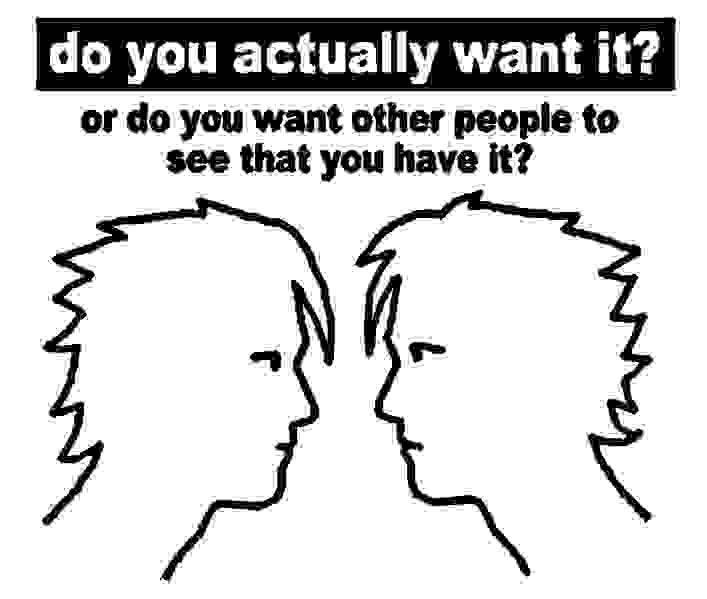
At some point, we have to ask whether the thing is actually good, or whether it is just good at making us want it.
Does the protein powder actually work, or do you just want your abs to look like the girl selling it?
Do the jeans fit well, or does the campaign make you want to become someone who wears it?
Would you still buy the product if the logo were blurred out?
That’s the question I keep coming back to.
Because the issue is not that celebrity brands exist. Some of them are genuinely great. The issue is that hyper-consumerism keeps convincing us that we are one more purchase away from becoming the version of ourselves we already know how to imagine.
Another nude lip liner. Another “clean girl” serum. Another activewear set. Another tiny bottle promising transformation.
The better strategy is probably less exciting, but much more useful: find what actually works.
The skincare brand your skin likes. The jeans that fit every time. The makeup you actually finish. The bag you reach for constantly. The pieces that become part of your life instead of another trend cycle you briefly participate in.

Taste is not just knowing what to buy.
Sometimes taste is knowing what not to buy.
So no, celebrity brands are not inherently bad. A good product is a good product, famous founder or not. But in a world where attention can be turned into a checkout button overnight, consumers should be a little more honest about what they are actually paying for.
Is it the product?
Or is it the identity it promises?